
Anyone looking for a starting price for a website on fokuus.be won't find one. You receive a custom quote from us, and we fix it before we start anything. The only fixed rate we publish is 80 euros per hour excl. VAT for individual jobs.
A price list would tell you little anyway. When you have a website built, you don't pay for a label like "one-pager" or "business website", but for hours of work, and how many hours that will be depends on five choices that are mostly yours to make. On top of that are external costs for domain name and hosting, which come back every year. Both can be known in advance.
Why an average price tells you little
What's the average cost of having a website built? A reliable average for Belgium doesn't exist. The price ranges you find online are set by web agencies themselves on their sites, and for the same label they vary widely: line up two agencies' one-pagers side by side and the ranges sometimes don't even overlap. That doesn't make either one wrong. There's simply different work behind it.
What an hour costs also differs per builder. The only neutral figure I found comes from UNIZO: according to their Freelancer Focus Report 2025, freelancers in Flanders and Brussels charge an average of 84 euros per hour across all sectors, from consultancy to education. I couldn't find a separate figure for web development.
For a first indicative price for your project, use our quote calculator: four short questions, then your name and email, and you receive a personal price range by email.
The five choices that determine your price
With each of those five choices, you can deliberately move towards the lighter or heavier option.
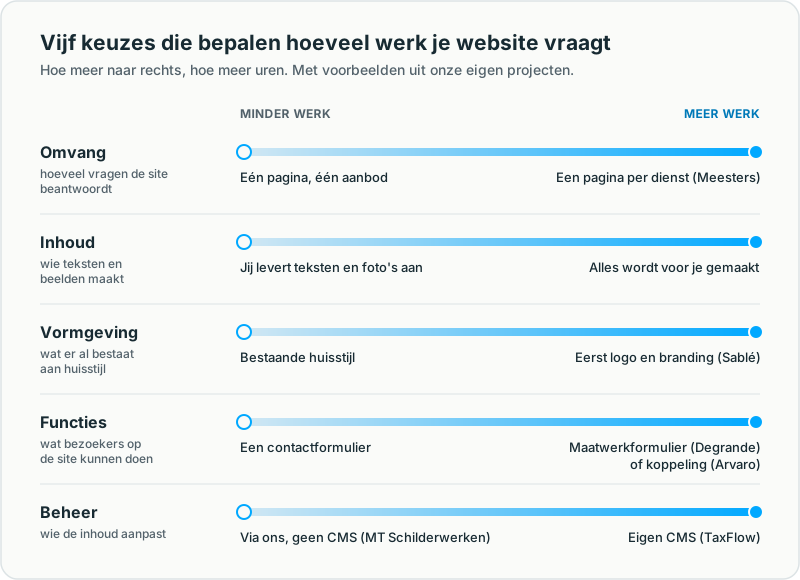
Scope is about how many questions your site needs to answer. MT Schilderwerken, a painter working in the Ghent region, received from us a compact website with a single task: introduce the business and enable quote requests. Meesters Vloerverwarming got its own service page per system, from tacker systems to cut-in, each with explanation and a quote form. That's more work, but someone searching for a specific system finds the right information straight away.
With content, look carefully at what is NOT in a quote. Who writes the text, who provides the images? If it's not explicitly stated, assume you'll do it. No problem, but factor in your own hours.
For design, what already exists matters. An existing house style you translate to the web. For Sablé, a specialist in pearl blasting, we created the logo, branding and website within the same project. That's design work on top of the site itself.
Functions are the least visible in a design. A contact form is standard work. For Degrande we developed a transport request in five steps: customers enter multiple vehicles, including licence plate and chassis number, plus separate pickup and delivery details. For Arvaro we built a central management system: a vehicle is entered in one place, and the listing is linked to their own website, AutoScout24 and Facebook Marketplace, within what those platforms allow. Such functions require their own analysis, build and testing.
The question remains whether you want to update content yourself. MT Schilderwerken uses no CMS: they discuss changes with us and we implement them once approved. TaxFlow's team publishes news and job postings directly in WordPress. A WordPress project typically costs more with us than a site we code ourselves, mainly because of licences for paid plugins and heavier maintenance afterwards. If you genuinely publish yourself, that expense is money well spent. If you want it "just in case", you're paying for something you won't use.
Free or build it yourself: when that makes sense
Can you build a website for free? Yes. With the free Wix package you can build and publish a site without paying, but it will be at an address like yourname.wixsite.com/site, you can not link a custom domain to it and Wix ads only disappear with a paid package. Free sites on WordPress.com show WordPress.com ads to your visitors.
A website with its own domain name and without ads costs around 4 euros per month in the first year with a website builder, excl. VAT. That is an introductory price. The Personal plan on WordPress.com costs 4 euros per month in the first year, billed annually, with a free domain name for that year. After that it renews at a higher monthly fee, and you pay for the domain name separately from year two. The SiteBuilder from Combell is on promotion at 3.99 euros per month, normally 9.99 euros, and the domain name is also included free for the first year only; a .be domain renews at 46.99 euros per year. At the standard price with Combell, you're looking at approximately 14 euros per month. Everything excl. VAT, checked on 25 September 2026. Building it yourself mainly costs time: writing, photography and research are all down to you.
For anyone starting out and first wanting to know if there's demand for their offer, I think such a builder is a good place to start. Louis Van Belle started on Google Sites and hit limits: limited design options, little room to expand, for example with SEO settings, and always dependent on what Google allows. He then switched to a WordPress site that we built together and that he manages himself. That's how it should be: you pay for more once you hit a real limit, not upfront.
Free is no longer sensible once a customer's decision hinges on trust, and an address on wixsite.com with someone else's ads doesn't help. If someone is considering a quote of several thousand euros from you, they first look to see if your business looks professional online.
Costs that come back every year
You pay for the build once. Domain name, hosting and maintenance come back every year, and that's where there's a pitfall: the introductory price. DNS Belgium, the registry that manages .be, notes that many hosting companies attract new customers, often by offering cheaper registration in the first year. According to them, you pay an average of 19.65 euros per year for a .be domain, with fluctuations between 5 and 50 euros (as of their page in November 2024).
At Combell, a .be domain name, including a mailbox, costs 9.99 euros to register and 46.99 euros per year to renew. The Business package for web hosting costs 5.99 euros per month in the first year and then 19.49 euros. Combell makes that clear too, and there's nothing wrong with a promotion. Just always factor in the price from year two.
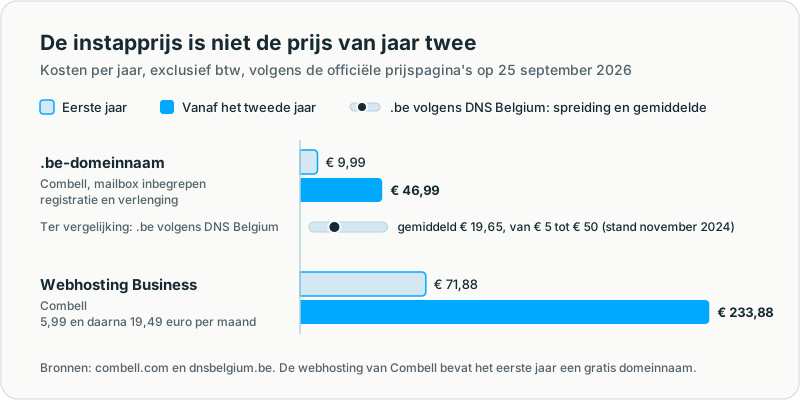
Maintenance is the third item, and how much there is depends mainly on your platform. A WordPress site with plugins needs structural updates, a static site much less. At Fokuus, hosting, domain and any licences are listed separately in the proposal, separate from the build price. That way you immediately see what's one-off and what recurs.
Finally, VAT. The prices from Combell, WordPress.com and Fokuus in this article are excl. VAT (this is not stated for the DNS Belgium and UNIZO figures), and the standard rate in Belgium is 21 percent. Ask with every quote whether the price is with or without VAT.
A website doesn't earn itself back automatically
Visitors alone earn you nothing back. At TaxFlow, a Google Ads campaign sent traffic to the old site, but that site didn't work with the campaign. Conversely, the best site won't convince anyone who can't find it, and for a local SME, discoverability often starts with a Google Business Profile, which you can create free of charge.
With Masters of Underfloor Heating they received four to five times as many quote requests in the first week after launch as before, according to their own feedback. That's an initial signal from the customer, not a measurement that rules out ads or other factors, and I won't build an annual return on it. But it does point to where a new site can deliver the most: with a business that already gets enquiries but is losing wavering visitors.
How to line up quotes side by side
Don't compare quotes on the final figure, but on what's included:
- exactly which pages and features you get;
- who creates the text and images;
- whether you can update content yourself, and with which system;
- recurring costs, with pricing from year two onwards;
- what an extra wish after delivery costs, and whose name the domain is registered in.
At Fokuus, we set the project price, payment schedule and scope before we start. New requests are discussed along with their impact on work, cost and timeline, individual jobs are charged at the hourly rate above, and we log the time we spend so you can see it. How such a process unfolds, complete with project examples, you can read on our page about having a website made in Kortrijk.